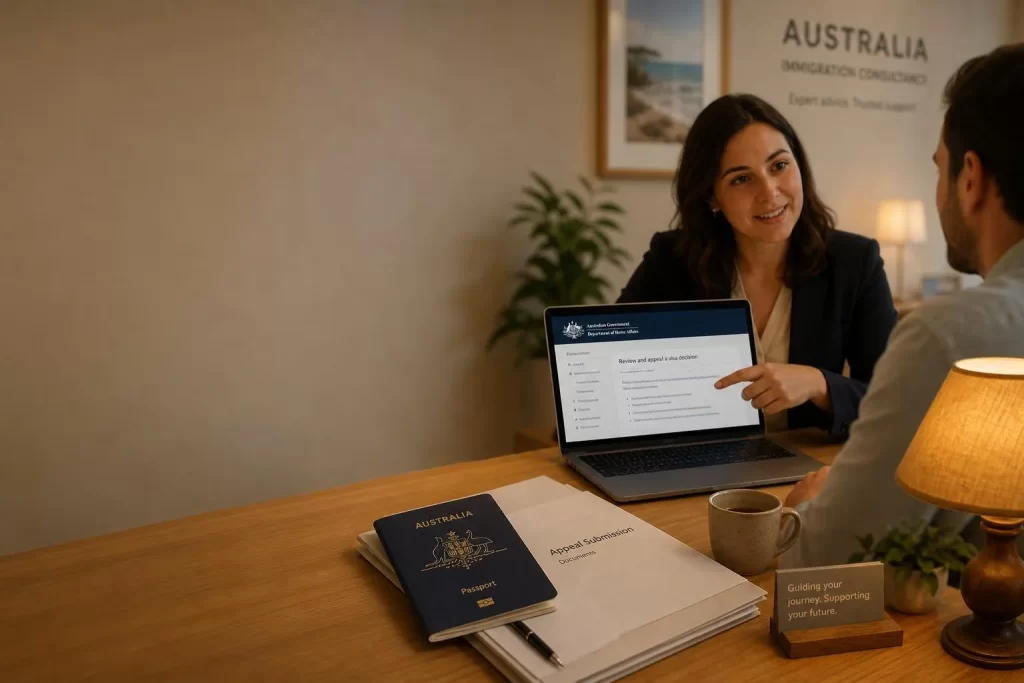

Refusal appeals at the AAT allow migrants to seek an independent merits review of a Department of Home Affairs visa refusal under federal migration law. The Tribunal reassesses facts, law, and discretion, can accept new evidence, and may affirm, set aside, or remit the decision. Strict statutory deadlines apply from notification. Professional guidance improves evidence strategy and hearing preparation.
Key Legal Points
- Refusal appeals are AAT merits reviews of Department visa refusal decisions
- They matter because an independent reviewer can reassess facts, law, and discretion
- Strict statutory deadlines apply from notification with no general extensions
- AAT can consider new evidence but cannot grant visas directly
- Map evidence to each failed criterion with clear, corroborated documents
- Common pitfalls include late lodgement and unfocussed, inconsistent submissions
- Costs include AAT fees, translations, tests, checks, and possible expert reports
Refusal appeals are applications to have the Administrative Appeals Tribunal, or AAT, review a Department of Home Affairs decision to refuse a visa. In simple terms, you ask an independent merits reviewer to reassess your case. The reviewer looks at the facts and law afresh, then makes the correct and preferable decision.
Refusal Appeals: Understanding the Aat Review
Legal Framework
Refusal appeals in migration matters occur in the AAT’s Migration and Refugee Division under the Migration Act 1958 (Cth). Merits review means the Tribunal stands in the shoes of the original decision-maker and can consider new evidence. Time limits are strict and depend on the visa class and whether the applicant is in Australia.
Key Definitions
Merits review means the AAT reconsiders facts, law, and discretion. Applicant is the person seeking review. Delegate is the original Department decision-maker. Affirm keeps the refusal, set aside replaces it, and remit sends it back to the Department to reconsider with directions.
What the Aat Can and Cannot Do
The AAT can consider fresh documents and witness evidence, test credibility, and apply current law and policy. It cannot grant visas itself. If it sets aside or remits a decision, your case returns to the Department for final action consistent with the AAT’s findings.
Process / Steps for Refusal Appeals
Step-by-step Process
- Read the refusal letter carefully, note the legislative criteria and time limit
- File the AAT application online with the correct fee before the deadline
- Request the Department file and identify key adverse findings to address
- Prepare a targeted evidence bundle mapped to each failed criterion
- Submit written submissions, then attend a hearing if listed
- Receive the AAT decision, and act promptly on any directions
Documentation Needed
- Identity and status documents matching application records
- Evidence addressing specific criteria cited in the refusal
- Updated statements and any expert or employer letters
- Translations and certified copies where required
- Chronology, index, and concise submissions explaining relevance
In real scenarios, we see applicants succeed when every exhibit is tied to a criterion with pinpoint references. A short, focussed submission often outperforms a large, unfocussed document dump.
What to Expect at the Hearing
Most refusal appeals involve an interview-style hearing with a Member who asks clarifying questions. You may bring a representative and witnesses. Preparation should include mock questions, consistent evidence across statements and forms, and clear explanations for any discrepancies.
Common Mistakes in Refusal Appeals
What to Avoid
- Missing the filing deadline by assuming an extension is available
- Re-submitting the original visa pack without addressing the refusal reasons
- Raising new claims that do not relate to the decision under review
- Ignoring adverse credibility findings without corroboration
- Overlooking public interest criteria and health or character issues
Real-world Examples
Common patterns include partner visa applicants failing to address cohabitation evidence gaps, or skilled applicants neglecting to reconcile employment start dates with tax records. Where an English test expires, success often requires a new valid test coupled with an explanation of prior timing issues.
Evidence Pitfalls
Unauthenticated documents, unsigned letters, and unexplained inconsistencies undermine credibility. In refusal appeals, one strong, verifiable piece of evidence usually outweighs multiple weak items. Cross-check dates across forms, statements, and supporting records before filing.
Deadlines, Limits, and Costs
Time Factors
Time limits run from notification of the refusal and can be as short as a few weeks. The AAT strictly applies these limits under the Migration Act 1958 (Cth) Part 5 review provisions. File early, then refine your evidence rather than risking a last-minute application.
Financial Considerations
Application fees apply, with partial refunds if the decision is favourable. Budget for translations, medicals, police checks, and potential expert evidence. We see clients reduce costs by prioritising the single most probative document per issue rather than collecting numerous marginal items.
Scope and Limits
The AAT cannot consider matters outside the original decision scope. For example, in skilled visas, late-added occupations generally fall outside scope. If a protection claim arises, separate procedures may apply and should be taken promptly.
Consequences and Outcomes
What Happens after the Decision
If the AAT affirms the refusal, options may include a Federal Circuit and Family Court judicial review on legal error grounds, if available, or making a fresh application where lawful. If the AAT remits, the Department typically finalises remaining checks, then decides the visa with the AAT’s findings applied.
Compliance Requirements
Bridging visa status may continue during refusal appeals, but conditions still apply. Monitor travel and work restrictions. If an affirm decision ends your lawful stay, seek advice immediately about any available bridging visa or voluntary departure arrangements.
Getting Help with Your Appeal
When to Seek Assistance
Complex refusals, including character, health, or public interest criteria, benefit from legal assistance. Learn more about initial response strategy in How To Respond To Visa Refusal In Australia. Professional representation for merits review is available through Immigration Appeals Reviews.
Choosing a Representative
Look for experience with your visa stream, clear communication, and document-mapping discipline. Ask how the adviser will test your evidence against each criterion and manage credibility issues. A focussed plan and mock hearing usually deliver better outcomes than generic templates.
Practical Impact
In real scenarios, we see improved prospects where applicants identify three critical issues early, then build concise, corroborated proof for each. AAT Members appreciate precise referencing and candid explanations for past inconsistencies.
How Long Do Refusal Appeals Take and What Improves Timing
Typical Timeline
Processing times vary with caseload and complexity. Straightforward evidence and prompt responses to directions can shorten matters. Delays often arise when new issues surface late, for example unanticipated health checks or unverified employment claims.
Ways to Reduce Delay
File early, pre-book tests, and pre-prepare statutory declarations. Keep a clean bundle with an index, tabbing, and page references in submissions. Clear, complete materials reduce follow-up requests and streamline hearings.
How to Resolve / Next Steps
Practical Guidance
Refusal appeals succeed when you link evidence directly to failed criteria and confront credibility issues head-on. Keep submissions brief, accurate, and referenced. If scope problems arise, consider whether a fresh application with corrected information is strategically stronger than persisting on review.
Recommended Actions
- Note your deadline and file a valid AAT application today
- Map refusal reasons to a targeted evidence list
- Fix inconsistencies across forms, statements, and records
- Prepare for focused hearing questions with mock interviews
- Act on the AAT outcome promptly to maintain lawful status
Frequently Asked Questions
What is an AAT refusal appeal and how is it different from judicial review?
An AAT refusal appeal is a merits review where the Tribunal reassesses facts, law, and discretion to reach the correct and preferable decision. Judicial review, by contrast, looks only for legal error. The AAT can consider new evidence, while judicial review cannot reweigh facts or substitute its own decision.
How long do I have to lodge a refusal appeal with the AAT?
Time limits are strict and vary by visa stream and notification method. Many migration refusal appeals must be lodged within a few weeks of notification. The deadline on your refusal letter governs, and the AAT generally cannot extend it. File early, then refine your evidence afterwards.
Can I submit new evidence during my AAT refusal appeal?
Yes, the AAT can consider new documents and witness evidence. Focus on materials that directly address the criteria the Department found unsatisfied. Ensure translations are provided, authors are identifiable, and dates reconcile with your previous forms and statements to avoid credibility concerns.
Will the AAT grant my visa if I win the appeal?
The AAT does not grant visas. If the AAT sets aside or remits the refusal, your case returns to the Department. The Department then finalises any outstanding checks and makes the visa decision consistent with the AAT’s findings or directions.
What happens to my bridging visa during an AAT refusal appeal?
Many applicants remain on a bridging visa linked to their review. You must comply with work, study, and travel conditions. If the AAT affirms the refusal, your lawful status may end, so obtain advice promptly about any bridging visa options or departure arrangements.
What are the most common reasons AAT refusal appeals fail?
Frequent causes include missing the filing deadline, failing to address the specific refusal reasons, weak or inconsistent evidence, and ignoring credibility issues. Overly long submissions without clear references also harm prospects. A focussed, criterion-by-criterion approach improves outcomes.
Should I lodge a new visa application instead of appealing?
It depends on eligibility and any bar or limitation. Where defects are not fixable within AAT scope, a new application may be stronger if permitted. Seek advice on timing, bridging visa impacts, and whether AAT review or a fresh application best protects your position.
Legal Disclaimer
Important Notice: The information provided on this website is for general informational purposes only and should not be considered as specific legal advice. Laws may vary between Australian states and territories, and legal requirements can change over time.
For specific legal advice regarding your individual circumstances, please consult with a qualified Australian legal practitioner who can provide guidance tailored to your particular situation.
This content is accurate as of the date of publication. We recommend seeking current legal advice for any legal matters.