
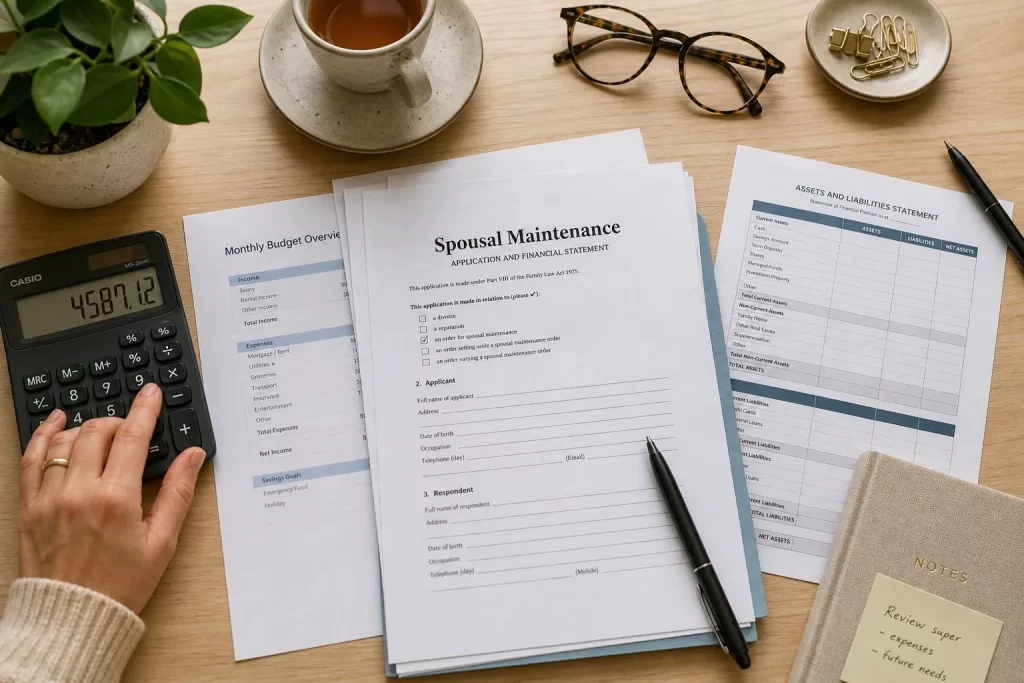
Spousal maintenance calculator Australia is a useful starting point, but courts do not use a fixed formula. Under the Family Law Act 1975 (Cth), maintenance depends on the applicant’s need and the other party’s capacity to pay. Calculate budgets, check income gaps, and apply the section 75(2) factors. Seek orders in the Federal Circuit and Family Court if needed.
Key Legal Points
- Spousal maintenance is needs based support, not a fixed formula
- Courts assess need and capacity to pay using section 75(2) factors
- Budget-based support calculation underpins persuasive maintenance proposals
- Interim orders available for urgent shortfall pending final resolution
- Time limits apply, 12 months post-divorce or 2 years post-separation
- Maintenance usually not taxable to recipient nor deductible to payer
- Accurate disclosure and consistent bank evidence are essential
Spousal maintenance calculator Australia is a helpful search, but there is no official formula. Spousal maintenance is court-ordered financial support one former spouse or de facto partner pays to the other after separation. It depends on need, capacity to pay, and what is just and equitable.
What Spousal Maintenance Means in Australian Family Law
Legal Framework
Maintenance is governed by the Family Law Act 1975 (Cth) section 72 and section 75(2) factors. The Federal Circuit and Family Court of Australia assesses two limbs, need and capacity to pay. There is no legislated calculator, only a principled assessment.
Key Definitions
- Need means a shortfall after reasonable living expenses
- Capacity to pay means surplus income after reasonable expenses
- Reasonable aligns with former living standards where possible
- Interim orders provide temporary support quickly
- Final orders resolve ongoing maintenance
What People Want to Know
- How to approximate maintenance without a rigid spousal maintenance calculator Australia
- What documents prove need and capacity
- Time limits and costs to apply
Using a Spousal Maintenance Calculator Australia: What IT Can and Cannot Do
What Calculators Estimate
Any spousal maintenance calculator Australia style tool can only provide a rough budget-based estimate. It helps list income, tax, essential expenses, and a monthly shortfall, then compare with the other party’s surplus. It is a financial needs assessment, not a binding outcome.
Why Courts Do Not Use Formulas
Circumstances vary widely, including health, care of children, earning capacity, and the standard of living. The court weighs section 75(2) factors and fairness across both households. A support calculation, in real scenarios, adjusts for housing, debt repayments, and childcare.
Data You Need for Any Support Calculation
- Recent payslips, tax returns, Centrelink and superannuation statements
- Bank statements detailing regular expenditure
- Evidence of health, study or childcare needs affecting earning capacity
Spousal Maintenance Calculator Australia, Step-by-step Method
Step-by-step Process
- List each party’s gross income, then net income after tax
- Itemise reasonable weekly expenses for both households
- Find the applicant’s shortfall and the respondent’s surplus
- Cross-check section 75(2) factors for adjustments
- Test affordability and duration, then propose an amount
Documentation Needed
Prepare a Financial Statement, budgets, and corroborating documents. Your financial needs assessment should be consistent with bank records and bills. Keep childcare schedules and medical evidence ready to explain work limitations.
Practical Examples
- Example 1: Applicant shortfall A$350 per week; respondent surplus A$420. A court may set around A$300 to A$350, allowing a modest buffer
- Example 2: Applicant has no income during retraining, but owns an unencumbered asset. Maintenance might be lower or time-limited pending job entry
- Example 3: High-income respondent with significant investment loans. The court may dissect which repayments are reasonable before calculating surplus
Requirements and Procedures in the Fcfcoa
Eligibility Requirements
The applicant must be unable to support themselves adequately, and the other party must have capacity to pay. Factors include age, health, care of children, income, property, and earning capacity. Married and eligible de facto partners are covered federally.
How to Apply
File an Initiating Application, affidavit, and Financial Statement. Seek interim orders if need is urgent. Many matters settle after exchange of disclosure and a support calculation consistent with budgets and section 75(2) considerations.
Interim Versus Final Orders
Interim maintenance fills the gap quickly on limited evidence. Final maintenance typically follows fuller disclosure or resolution alongside property settlement. Orders can be time-limited or reviewable.
Common Mistakes in Support Calculation
What to Avoid
- Using a rigid spousal maintenance calculator Australia figure without testing reasonableness
- Overstating discretionary costs, or omitting small but regular expenses
- Ignoring tax effects or double-counting child support
Real-world Patterns
Common patterns include underestimating transport, insurances, and medical costs. In real scenarios, we see budgets fail because they exclude school extras, subscriptions, or irregular utilities. Careful line-by-line review prevents disputes.
Deadlines, Limits and Costs
Time Limits
For married couples, file within 12 months of divorce. For de facto couples, file within 2 years of separation. Out-of-time applications need leave, which is not automatic and carries risk.
Financial Considerations
Maintenance is typically not taxable to the recipient nor deductible to the payer. Budget for filing fees and potentially contributions to legal costs in complex matters. Consider interaction with property settlement and any lump-sum maintenance.
Interaction with Child Support
Child support is distinct and usually assessed first. The maintenance calculation then focuses on adult support needs. For parents, learn more about negotiation pathways in Mediation In Family Law.
Consequences of Getting IT Wrong or Not Paying
Non-compliance Outcomes
Unpaid maintenance can lead to enforcement, interest, and costs orders. The court may issue garnishee orders or seizure. Alleged payers should promptly seek variation if circumstances change.
Variation, Suspension, and Ending Maintenance
Orders can be varied for material change, such as new employment or illness. Maintenance may end on new marriage or as specified by order. Keep records to demonstrate genuine attempts at compliance.
How to Resolve Disputes and Next Steps
Negotiation and Mediation Pathways
Exchange disclosure, build realistic budgets, and run a support calculation both ways. Many disputes resolve at mediation using the same inputs a court expects. Document agreed figures in consent orders.
When to Seek Professional Help
Expert assistance with spousal maintenance is available through Spousal Maintenance. For background principles and examples, see our explainer Spousal Maintenance.
Preparation Checklist
- Three months of bank statements and recent payslips
- Annual budgets with evidence for each line
- Childcare, schooling, health, and housing documentation
- Draft proposal showing need, capacity, and duration
Frequently Asked Questions
Is there an official Australian spousal maintenance calculator?
No. The Family Law Act does not prescribe a formula. Courts assess need and capacity to pay using section 75(2) factors. Budget tools help estimate a shortfall and surplus, but outcomes depend on evidence, reasonableness of expenses, and fairness across both households.
What documents do I need to claim spousal maintenance?
Provide a Financial Statement, payslips, tax returns, bank statements, bills, childcare costs, medical evidence if relevant, and any documents showing attempts to find work or retrain. Consistency between budgets and bank records is critical for credibility in interim and final applications.
How quickly can interim spousal maintenance be ordered?
Interim orders can be made relatively quickly on affidavit material where immediate need is shown. Timeframes vary by list availability, but urgent listings may be sought. Prepare a concise budget, clear evidence of shortfall, and calculations demonstrating the other party’s capacity to pay.
Does child support affect spousal maintenance?
Yes. Child support is generally considered first. The court then assesses spousal maintenance focusing on adult support needs. Do not double-count children’s expenses in both calculations. Set out the child support amount and then demonstrate any remaining adult shortfall.
Are spousal maintenance payments taxable?
Typically, periodic spousal maintenance is not taxable to the recipient and not deductible for the payer in Australia. Confirm your position with current ATO guidance and seek tailored tax advice if paying lump sums, arrears, or where orders intersect with property settlement.
What are the time limits to apply for maintenance?
For married couples, apply within 12 months of divorce. For de facto couples, within 2 years of separation. Applications outside these limits need leave of the court, which requires explaining the delay and demonstrating hardship or strong merits.
Can maintenance be varied or stopped later?
Yes. Orders may be varied or discharged if there is a material change, such as new employment, illness, or altered care arrangements. Keep records of income and expenses and seek prompt legal advice before arrears accrue, as enforcement can add interest and costs.
Legal Disclaimer
Important Notice: The information provided on this website is for general informational purposes only and should not be considered as specific legal advice. Laws may vary between Australian states and territories, and legal requirements can change over time.
For specific legal advice regarding your individual circumstances, please consult with a qualified Australian legal practitioner who can provide guidance tailored to your particular situation.
This content is accurate as of the date of publication. We recommend seeking current legal advice for any legal matters.