
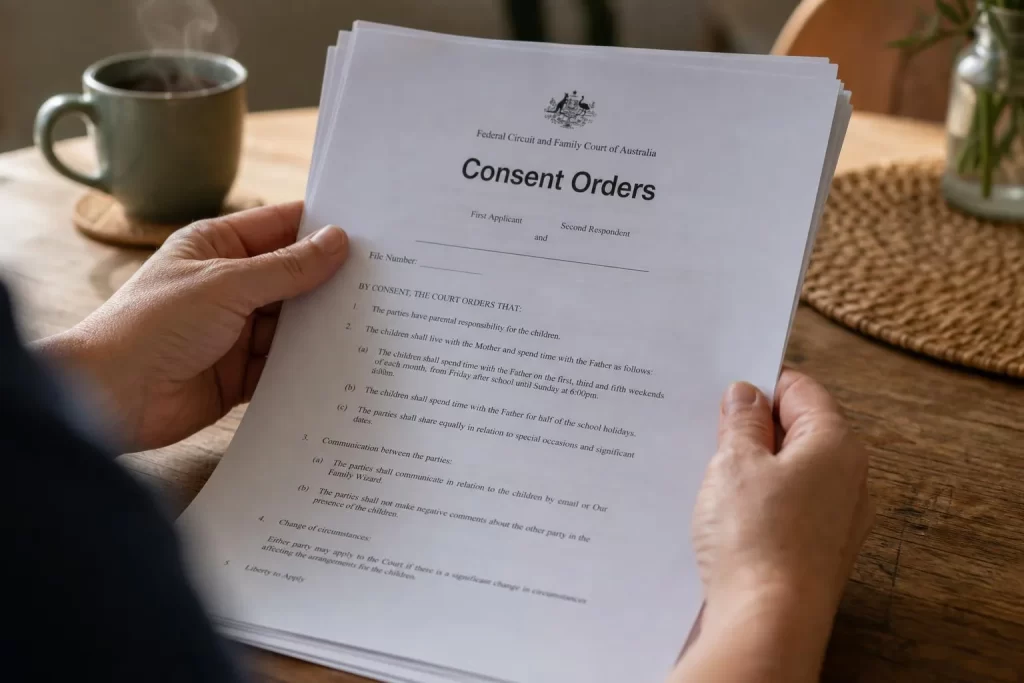
Consent orders australia are Court-approved agreements that formalise parenting, property, and spousal maintenance arrangements after separation. They are made by the Federal Circuit and Family Court of Australia without a hearing if terms are appropriate. Parenting orders must meet the child’s best interests, and property orders must be just and equitable. They provide enforceability, finality, and practical certainty.
Key Legal Points
- Consent orders are Court-approved agreements that become enforceable family law orders
- They cover parenting, property division, superannuation splits, and spousal maintenance
- The Court checks best interests for parenting and just, equitable outcomes for property
- Applications are usually paper-based, avoiding hearings and reducing legal costs
- Time limits apply post-divorce and for de facto separations to file property orders
- Clear drafting with deadlines and fallback clauses avoids enforcement disputes
- Parenting plans are not enforceable, unlike parenting consent orders
Consent orders australia are written agreements approved by the Federal Circuit and Family Court of Australia that become legally enforceable orders. They record a family law settlement for parenting, property, and spousal maintenance without a court hearing. Properly drafted, they provide certainty and finality after separation.
Definition and Legal Basics
What Consent Orders Mean
Consent orders are court-endorsed terms that parties agree to after separation. They can cover parenting arrangements, division of property, and ongoing financial support. Once sealed, they carry the same force as orders made by a judge after a hearing.
- Parenting consent sets out responsibility, living arrangements, time, and communication
- Property orders finalise asset and liability division, including superannuation splits
- Spousal maintenance can be periodic or lump sum, with release clauses where appropriate
- Enforceability mirrors any court order, with penalties for breach
Legal Framework
The Court must be satisfied that parenting orders are in the child’s best interests under the Family Law Act 1975 (Cth) section 60CC. For property and maintenance, the Court considers whether the agreement is just and equitable, applying recognised contribution and future needs factors.
Common Search Intents Answered
When Should You Use Consent Orders Australia?
Use consent orders to formalise a negotiated settlement where both parties agree. They are preferred when you want enforceability that a simple parenting plan or informal property deal cannot provide.
Are Consent Orders Faster and Cheaper?
Typically yes. With complete paperwork and sensible terms, applications are determined on the papers, avoiding hearing delays and significant legal fees.
What Can Be Included?
Parenting time, decision-making, travel, communication, changeover logistics, school choices, property transfers, sale of real estate, superannuation splits, debt allocation, and spousal maintenance.
Benefits of Consent Orders Australia
Certainty, Finality, and Enforceability
Consent orders australia provide clear, binding terms that reduce future disputes. They close off property claims and clarify parenting responsibilities, creating stability for children and financial systems that lenders and super funds recognise.
Practical Advantages over Informal Agreements
- Enforceable if breached, unlike a parenting plan
- Recognised by third parties, enabling transfers, refinance, and super splits
- No attendance at court required if terms are appropriate
- Often quicker than litigating to a defended hearing
Examples from Real Scenarios
We often see parents settle on a school-holiday schedule and decision-making protocol that prevents later stand-offs. In property cases, common patterns include one party retaining the home with a refinance deadline and a back-up sale clause if finance fails.
Process and Steps to Obtain Family Law Consent Orders
Step-by-step Process
- Negotiate terms through direct discussion, lawyer-led negotiation, or mediation
- Draft proposed orders and supporting documents
- File the Application for Consent Orders online with filing fee
- Respond to any requisitions from the Court if raised
- Receive sealed orders and implement transfers, payments, and time arrangements
Documentation Needed
- Application for Consent Orders and Minute of Proposed Orders
- Financial disclosure for property matters, including valuations and super details
- Parenting proposals addressing best interests and practical arrangements
- Any annexures, such as a superannuation split letter of instructions
Using Mediation and Fdr
Most durable outcomes are secured after good-faith mediation. Learn more in Mediation In Family Law, which explains preparation, confidentiality, and settlement techniques that translate efficiently into consent orders.
Key Requirements and Court Assessment
Parenting Best Interests
The Court examines safety, meaningful relationships, capacity to meet needs, and practicality. Consent orders australia for parenting should address conflict points like travel authority, medical decisions, and school events.
Just and Equitable Property Split
For property, the Court assesses contributions, the asset pool, future needs, and whether the outcome is fair overall. Superannuation splits must specify fund details and operative time frames.
Drafting Standards
Orders must be clear, workable, and not vague. Include timeframes, fallback clauses, and mechanisms for information exchange to avoid ambiguity and enforcement problems.
Common Mistakes to Avoid
Drafting and Practicality Errors
- Unclear changeovers, school terms, or holiday definitions
- No refinance deadline or sale fallback for property transfers
- Forgetting lender or body corporate consents
- Super splits lacking required fund information
Overlooking Related Legal Needs
People often neglect to update wills and nominations after settlement, which risks unintended outcomes. See Why You Need A Will In Australia to align estate planning with your sealed orders.
Deadlines, Filing, and Costs
Time Limits after Separation
Applications for property or spousal maintenance must be filed within 12 months of a divorce order becoming final, or within two years of separating from a de facto relationship. Leave of the Court is required outside these limits.
Filing Fees and Professional Costs
There is a Court filing fee, with reductions in eligible cases. Legal drafting and negotiation fees vary with complexity. Consent orders australia usually minimise overall costs by avoiding litigation.
Consequences and Enforcement
What Happens if Orders Are Breached
- Parenting breaches may trigger contravention applications, make-up time, or other remedies
- Property breaches may lead to enforcement orders, warrants, or contempt consequences
- Costs orders can be made where non-compliance is unreasonable
Keeping Orders up to Date
If material circumstances change, parties may vary by agreement and seek new consent orders. For parenting, significant change is needed before asking the Court to revisit arrangements.
Parenting Consent Orders and Practical Tips
Designing Child-focused Arrangements
Address safety, routines, communication platforms, and travel logistics. Include notice periods for holidays and overseas trips, and detail handover locations to reduce friction.
Linking with Parenting Plans
Some families pair orders with a parenting plan for flexible detail. The orders remain the enforceable core, while the plan can adapt to minor changes without returning to court.
Property Settlement Terms That Work
Transfers, Sales, and Super Splits
Use realistic refinance dates, independent valuations, and orderly sale processes. For super splits, specify the base amount or percentage and the operative time for implementation.
Tax and Third-party Interfaces
Account for CGT rollover, transfer duty concessions, and lender requirements. Consent orders australia are commonly accepted by banks and funds, enabling timely implementation.
How to Resolve Issues and Next Steps
Practical Guidance
Map your parenting and property goals, exchange disclosure, and workshop scenarios. Test each clause against a ‘what if this fails’ checklist to ensure workable fallbacks.
Recommended Actions
Expert assistance with parenting arrangements is available through Parenting Orders And Parenting Plans. For Court process detail, the Court’s guide to applying for consent orders explains forms and criteria on its ‘Apply for consent orders’ page at fcfcoa.gov.au.
Professional Support and Governance
When to Seek Legal Help
Engage a lawyer if there are safety issues, complex structures, or super splits. In real scenarios, we see faster approvals and fewer requisitions where solicitors draft precise, practical orders.
Court Resources and Reliability
See the Federal Circuit and Family Court’s resource ‘Apply for consent orders’, which outlines eligibility, documents, and assessment. This supports accurate, complete filing for consent orders australia.
Frequently Asked Questions
Do I need to attend court to get consent orders?
Usually no. If your paperwork is complete and the terms are appropriate, the Court can make consent orders in chambers without a hearing. The registrar assesses best interests for parenting and just and equitable outcomes for property, then issues sealed orders by email or the portal.
What is the difference between a parenting plan and parenting consent orders?
A parenting plan is a written agreement but not enforceable as a court order. Parenting consent orders are approved by the Court and are enforceable, with remedies for breach. Many families prefer orders for certainty with changeovers, holidays, travel, and decision-making rules.
How long do consent orders take to be approved?
Timeframes vary with Court workload and whether requisitions are raised. Straightforward, well-drafted applications can be approved within weeks. Complex property pools, missing disclosure, or unclear parenting terms may extend the timeline until issues are clarified.
Can we vary consent orders later?
Yes, by agreement through fresh consent orders. For parenting, a significant change in circumstances is generally required if asking the Court to revisit without consent. For property, variations are less common once implementation is complete, except by consent or specific legal grounds.
Are there time limits for applying for property consent orders after divorce?
Yes. You must apply within 12 months of a divorce order becoming final, or within two years of the end of a de facto relationship. Outside these limits, you need the Court’s leave, which is discretionary and not guaranteed.
What if my ex-partner breaches the consent orders?
You may file a contravention or enforcement application. Remedies can include make-up time, compliance orders, enforcement of payments, and in serious cases, costs or other sanctions. Legal advice helps assess evidence and the most effective procedural route.
Can consent orders include superannuation splits?
Yes. Orders can split super between parties. They need precise fund identification, operative time, and an amount or percentage. Many funds require prior notification and a draft, so engage the fund early to avoid implementation delays.
Legal Disclaimer
Important Notice: The information provided on this website is for general informational purposes only and should not be considered as specific legal advice. Laws may vary between Australian states and territories, and legal requirements can change over time.
For specific legal advice regarding your individual circumstances, please consult with a qualified Australian legal practitioner who can provide guidance tailored to your particular situation.
This content is accurate as of the date of publication. We recommend seeking current legal advice for any legal matters.